Trade Show Lead Follow-Up: How to Convert Booth Visitors Into Customers
By Boothlyo TeamPublished Updated 10 min read
Why Trade Show Lead Follow-Up Matters
Collecting names at the booth is only the start. Trade show lead follow-up is what turns those conversations into meetings, opportunities, and revenue. When follow-up is slow, generic, or ownerless, leads go stale while competitors who were also on the floor stay top of mind.
Common failure modes after a show:
- Interest fades within days if nobody reaches out
- Lists sit in a notebook, badge dump, or shared spreadsheet with no clear owner
- Every lead gets the same blast — high-intent prospects are treated like badge scans
- Nobody can see who was contacted, who is overdue, or what converted
- Marketing and sales argue about "bad leads" instead of a shared process
Following up on trade show leads is a management problem as much as a messaging problem: organize the list, prioritize it, assign it, work it, and track it through conversion.
Build a Trade Show Lead Follow-Up Process
Use a simple loop exhibitors can run after every show: organize → prioritize → assign → follow up → track.
1. Review and organize leads
Get every lead into one place as soon as the show ends — not scattered across phones, cards, and chat threads. Central records should include contact details, show name, notes from the conversation, and any interest signals captured at the booth. Digital trade show lead capture (QR or manual entry) makes this step much faster than paper.
2. Prioritize leads
Separate high-intent conversations from casual scans before you blast the whole list. A practical model is Hot / Warm / Cold based on buying intent, timeline, and fit — a staff judgment call using what you learned on the floor, not a black-box number. Hot leads get personal outreach first; warm get tailored follow-up; cold get lighter nurture.
3. Assign ownership
Every meaningful lead needs a responsible person. Route existing accounts to owners, align new logos by territory or vertical, and only fall back to round-robin after hot/warm routing. Cap daily assignments so quality does not collapse the week after the show.
4. Follow up quickly
Reach out while the booth conversation is still familiar. Reference what you discussed, attach what you promised, and propose a clear next step. Do not wait for "next Monday" if hot leads are sitting untouched.
5. Track the outcome
Move each lead through a visible path: contacted → qualified → converted — or mark it lost when it is not a fit. Record when first outreach happened so you can see overdue leads and improve the next show's process.
A Practical Post-Show Follow-Up Timeline
Timing will vary by industry and deal cycle. Treat this as a useful framework, not an absolute rule.
Within 24 hours
- Consolidate leads into your central system
- Confirm who owns hot and warm leads
- Prioritize high-value conversations
- Begin first outreach on hot leads (call or personalized email)
- Send promised assets from booth conversations
Within several days
- Complete first touches on warm leads
- Record responses and next steps
- Advance leads that engage (e.g., toward qualified)
- Try a second channel if there is no reply on priority leads
After the initial wave
- Identify leads that still have not been contacted
- Continue appropriate outreach or nurture for cold/fit leads
- Decide which conversations are real opportunities
- Track conversions and lost leads so the show's results are honest
Teams that treat the first day after the show as part of the event — not "back to the office" — consistently protect more of the pipeline they paid to create.
Trade Show Lead Management: Organizing Leads After the Event
Trade show lead management is the process of organizing, qualifying, assigning, following up with, and tracking the leads collected at an event — until each one converts, nurtures, or is closed out.
Follow-up works better when management basics are in place:
- Centralized lead records per event (and across your show calendar)
- Clear ownership so leads are not "everyone's problem"
- Qualification (Hot / Warm / Cold plus notes)
- Pipeline stages so status is visible, not tribal knowledge
- Follow-up status and timestamps so you know whether outreach started
- Overdue visibility for leads that never got a first touch
- Conversion tracking so you can connect booth effort to outcomes
Without that structure, even strong email templates cannot save a messy list. Lead management is how exhibiting teams turn a show dump into a workable pipeline — especially when you run multiple events a year inside a broader exhibiting program.
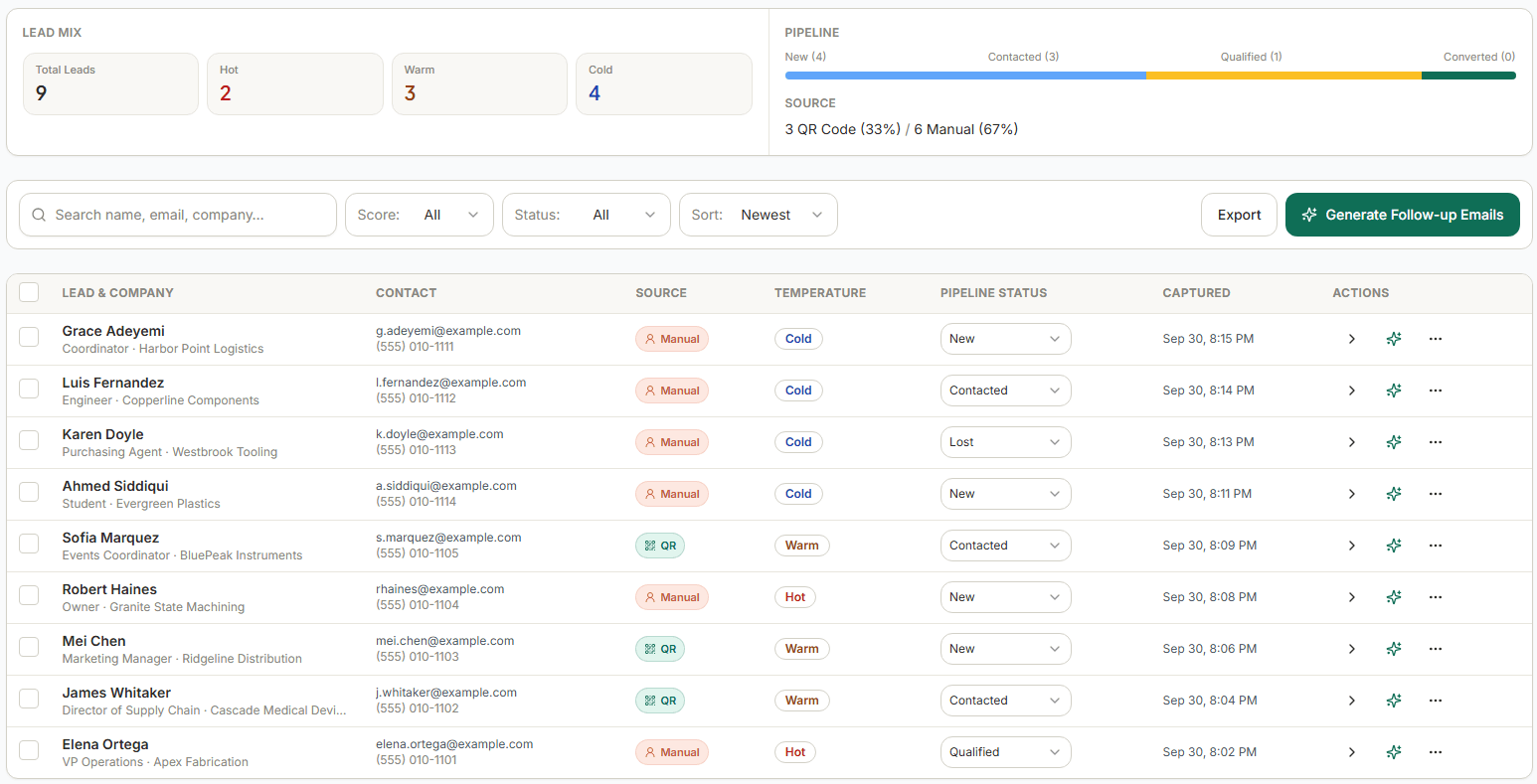
Hot, Warm, and Cold Follow-Up Sequences
Hot means budget, timeline, and fit align — they asked for pricing, introduced you to a decision-maker, or requested a demo next week.
Day 0 (same day if possible): Phone call or personalized email referencing booth conversation. Confirm next step on calendar.
Day 1: Send promised asset — spec sheet, case study, pricing range — with one clear CTA.
Day 3: Second touch if no response; try alternate channel (LinkedIn, phone).
Day 7: Manager escalation or breakup email — still personalized.
Assign to your best closer, not round-robin junior reps.
Warm lead follow-up sequence
Warm means real interest but longer cycle or unclear authority.
Within 48 hours: Email with show reference, discussion topic, and soft CTA (15-minute call).
Day 5: Value-add follow-up — industry insight, not "just checking in."
Day 14: Third touch with different angle (video, invite to webinar).
Day 30: Move to nurture or re-qualify.
Cold lead nurture sequence
Cold means badge scan with minimal conversation — still worth nurture if ICP fit.
Week 1: Thank-you for visiting, one helpful resource, no hard pitch.
Weeks 2–4: Educational emails tied to problems you solve.
Days 30–60: Case study and offer to assess fit on a call.
Drop if no engagement after 90 days; focus budget on shows and segments that convert.
Trade Show Meeting Follow-Up
Many of your best post-show opportunities did not come from a badge scan — they came from a scheduled or booth-side meeting. Treat meeting-generated leads with extra care.
After each meaningful meeting:
- Record the outcome — what was discussed, interest level, objections, and any promised materials
- Assign the right owner — usually the person in the meeting, or the account owner if one exists
- Capture next steps — demo, proposal, intro to a stakeholder, or a definite "not a fit"
- Follow up while the conversation is fresh — same-day or next-day notes beat a generic "great to meet you" blast a week later
- Track the lead through your pipeline — meeting → contacted → qualified → converted (or lost)
Meeting follow-up is still manual outreach from your team's email or phone — the advantage is organization and memory, not automation for its own sake.
Trade Show Lead Follow-Up Emails
Generic "Thanks for visiting our booth!" blasts usually underperform because they ignore the conversation that made the lead valuable.
Stronger trade show lead follow-up emails:
- Name the show, city, and when you met
- Reference the prospect's stated interest or problem
- Attach or link only what is relevant
- Make the next step obvious (two time options or a calendar link)
- Follow up consistently if there is no reply — without nagging daily
- Update lead status when you send and when they respond
If you cannot personalize a message at all, the gap is usually capture quality at the booth, not copywriting. Improve notes and questions during lead capture, then write follow-ups that continue the conversation.
Email Templates by Lead Priority
Hot lead template
Subject: Great meeting you at [Show Name] — next steps for [Their Company]
Hi [Name],
Thanks for stopping by our booth at [Show Name] on [Day]. I enjoyed our conversation about [specific topic] and how [your product] could help with [their stated goal].
As discussed, I am attaching [asset]. I would like to schedule a 30-minute call to [specific outcome]. Here are two times that work on my end: [Option A] / [Option B], or [calendar link].
Best,
[Your name]
[Phone]
Warm lead template
Subject: Following up from [Show Name]
Hi [Name],
It was good to meet you at [Show Name] last week. You mentioned [challenge] — we have helped similar teams in [industry] with [brief outcome].
If helpful, I can share a short overview tailored to [Their Company]. Would a 15-minute call next week make sense? [calendar link]
Thanks,
[Your name]
Cold lead template
Subject: Resources from [Show Name]
Hi [Name],
Thanks for visiting us at [Show Name]. If [problem area] is on your roadmap this year, this [guide/case study] outlines how teams like yours approach it.
No pressure — reply if you would like to explore fit, or I will check back in a few weeks.
Best,
[Your name]
Customize every bracket. Templates are scaffolding, not mail-merge spam — send from your own email tool.
Assign Ownership and Track Outcomes
Rules that work:
- Account owner takes existing customers/prospects
- Geographic or vertical alignment for new logos
- Round-robin only after hot/warm routing
- Cap daily assignments so quality does not collapse show week after
For tracking, prefer fields you can actually maintain:
- Lead source = exact show name
- Priority at capture (Hot / Warm / Cold)
- Owner / responsible rep
- First-touch date and channel
- Pipeline stage (new → contacted → qualified → converted, or lost)
- Opportunity / outcome when applicable
Export to CSV or Excel when you need the list in another tool. Use dashboards for time-to-first-touch, meetings booked per show, and pipeline attributed to each event — then compare against cost-per-lead from your ROI calculation work.
Measure Conversion From Trade Show Leads
Track:
- Lead-to-meeting rate by show
- Meeting-to-opportunity rate
- Opportunity-to-close rate within 6–12 months
- Revenue influenced vs closed-won
Compare to CPL from your budget and ROI work. A show with high lead count and zero meetings is a qualification problem, not a follow-up problem — but you only know if you measure. In Boothlyo, follow-up and lead analytics show contacted rate, average time to first follow-up, and overdue leads per show; for cost and return, see ROI tracking.
How Boothlyo Supports Post-Show Lead Follow-Up
Boothlyo is built for exhibiting teams that need capture and follow-through in one place — without turning this guide into a product brochure.
After (and during) a show, teams use Boothlyo to:
- Capture leads via public QR, staff-specific QR, or manual entry
- Categorize leads as Hot, Warm, or Cold (staff-assigned; not an AI numeric score)
- Track which staff member captured each lead at the booth
- Move leads through New → Contacted → Qualified → Converted, with Lost as a separate exit
- Record follow-up timestamps when outreach is marked
- See overdue untouched leads and 24-hour SLA follow-up performance in analytics
- Generate reusable follow-up email templates you copy and send from your own email tool
- Export leads to CSV or Excel
- Manage leads at the event and organization level
- Review lead and follow-up analytics to improve the next show
Boothlyo does not send automated nurture campaigns — your team owns outreach. It can send captured leads to HubSpot as contacts, including their lead status (one-way); Salesforce and Mailchimp are not supported today. Boothlyo helps you organize, prioritize, track, and export.
Capture and organize leads at your next show with Boothlyo. Get started, then run follow-up while the conversation is still fresh.
Sales and Marketing Alignment After the Show
Marketing owns export hygiene: dedupe, correct show tag, priority preserved. Sales owns first-touch SLAs. Agree before the show who gets alerted when hot leads sit untouched. A shared dashboard beats blaming "the list was bad" when nobody called.
RevOps should audit ten random leads per show quarterly: Was source correct? Was first touch on time? Did opportunity stage advance? Patterns reveal whether to fix capture, assignment, or messaging — not whether trade shows "work."
Legal and Compliance Reminders
If your industry restricts email outreach, templates still work for phone and LinkedIn. Include opt-out language where required. Business cards with handwritten notes still need system entry — assign a data entry owner for day-one evening so stacks do not sit on a desk for two weeks.
Improve notes and questions at the booth with lead capture strategies; this guide finishes the job sales starts.