How to Calculate Trade Show ROI: Formulas, Benchmarks, and What to Track
By Boothlyo TeamPublished 10 min read
Can you answer "was this show worth it?"
If finance asks for ROI and you offer anecdotes, exhibit budgets shrink next year — regardless of whether the show actually worked. Measuring trade show ROI is a skill: four core metrics, clear formulas, benchmarks, attribution rules, and a story leadership understands.
This guide is for exhibitors calculating ROI on their spend — not organizers selling floor space.
Why most exhibitors cannot answer the question
Data breaks in three places:
- Costs scattered — finance, marketing, and ops each hold different invoices
- Leads anonymous — badge scans without qualification or CRM source
- Revenue unattributed — deals close six months later with no show tag
Fix capture and cost discipline first; formulas are easy once data exists.
The four metrics every exhibitor must track
Total show cost
Sum actuals across booth, freight, travel, labor, technology, materials, services, and contingency. Use closed books within ten days post-show — see trade show budget template.
Leads captured
Raw count plus qualified count. Qualification definition must be consistent booth to booth.
Pipeline generated
Opportunity dollar value created or advanced within 90 days where show was a touchpoint. "Influenced" pipeline counts for long cycles.
Revenue influenced
Closed-won or committed revenue with show attribution in CRM — even if close happens later.
Two more numbers are worth recording for every show, even though they are not part of the core four: meetings held (scheduled and walk-up), because they are the earliest signal of pipeline, and revenue closed with show attribution, kept separate from influenced revenue so the two are never blurred.
Cost per lead formula
CPL = Total show cost ÷ Number of qualified leads
Example: $24,000 cost, 80 qualified leads → $300 CPL.
Compare CPL to:
- Other marketing channels for same ICP
- Your prior shows (year-over-year)
- Target CPL finance approved in planning
Rising CPL with stable close rates may still be acceptable if deal size is large — context matters.
Industry benchmarks for cost per lead
Benchmarks vary wildly by industry and deal size:
- Industrial B2B: CPL $150–$400 often cited for qualified leads
- Technology/SaaS: $200–$600+ depending on ACV
- Medical/pharma: higher compliance costs push CPL up
Two process benchmarks matter as much as CPL: follow-up within 48 hours for hot leads, and a post-show report to leadership within two weeks. Teams that miss either usually cannot produce a credible ROI number later.
Use benchmarks to sanity-check, not to judge a show in isolation. Your historical trend is the benchmark that matters.
How to attribute revenue to a trade show
Rules that hold up in leadership reviews:
- Tag every lead at capture with show name and date
- Require sales to maintain lead source on opportunities
- Define "influenced" vs "sourced" — sourced started at show; influenced had show touch before close
- Review pipeline 30/60/90 days post-show — do not wait only for closed-won
For multi-touch deals, document show role in opportunity notes — politics is easier with paper trail.
The 3–6 month revenue window problem
Short-term ROI looks at meetings and pipeline within 90 days — good for operational feedback.
Long-term ROI needs 6–12 months for enterprise cycles — good for budget renewal.
Report both so leadership does not kill a show that converts slowly but profitably.
Short-term vs long-term ROI presentation
| Horizon | What to show |
|---|---|
| 30 days | Leads, meetings, CPL, hot lead follow-up rate |
| 90 days | Pipeline created, stage progression |
| 12 months | Closed-won, ROI %, payback period |
How to present trade show ROI to your CEO or VP
One slide per major show:
- Investment (actual)
- Qualified leads and CPL
- Meetings held
- Pipeline influenced ($)
- Revenue closed or forecast ($)
- ROI % = (Revenue or pipeline value − cost) ÷ cost × 100
- Recommendation: invest / maintain / reduce / skip
- Operational changes next cycle
Avoid forty-tab spreadsheets in the meeting; attach detail as appendix.
ROI calculation spreadsheet template
Columns per show:
- Cost categories → total actual
- Leads raw / qualified
- CPL (formula)
- Meetings count
- Pipeline influenced
- Revenue closed
- ROI % (formula)
- Notes / learnings
Link lead count to CRM export or Boothlyo dashboard so numbers reconcile.
Red flags: when a show is not worth attending again
- Qualified leads below internal minimum for three consecutive years
- CPL 2× your channel average with no larger deal size
- Zero meetings with target accounts despite traffic
- Team reports ICP mismatch — wrong audience
- Operational cost to exhibit exceeds incremental gross profit
Pause and fix before canceling forever — sometimes booth message or capture failed, not the show itself.
Green flags: invest more
- CPL improving year-over-year
- High meeting-to-opportunity conversion
- Named accounts engaged that were cold before
- Competitors visible and winning — signal of buyer presence
- Sales requests return without marketing pushing
How Boothlyo calculates ROI and cost per lead
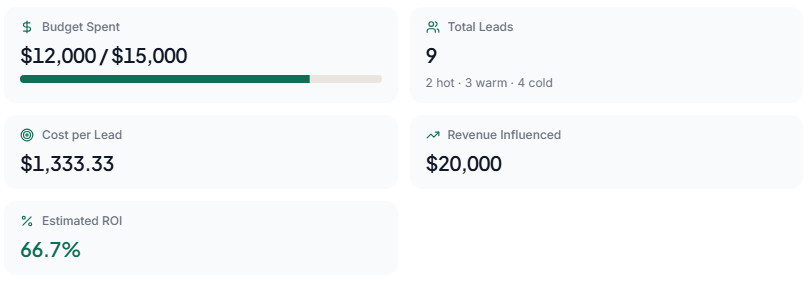
Manual consolidation dies when you run five shows a season. In Boothlyo, each event's budget actuals and captured leads sit on the same record, so cost per lead is calculated as you go, and ROI is calculated once you enter the revenue attributed to the show. Two details matter when you compare its numbers with this guide: Boothlyo's cost per lead divides actual spend by all captured leads (not only qualified ones), and revenue is entered by your team rather than pulled from a CRM. See how ROI tracking works in Boothlyo, then carry the results from lead follow-up into the numbers leadership asks for.
Worked example: measuring trade show ROI end to end
Inputs: Actual cost $28,500. Qualified leads 95. Meetings held 22. Pipeline influenced within 90 days: $410,000. Closed-won within 12 months attributed to show: $120,000.
CPL: $28,500 ÷ 95 = $300.
Short-term ROI (pipeline lens): ($410,000 − $28,500) ÷ $28,500 × 100 ≈ 1,338% — leadership must understand pipeline is not cash in bank.
Closed-won ROI: ($120,000 − $28,500) ÷ $28,500 × 100 ≈ 321% — still strong if margin supports it.
Present both numbers with assumptions documented. Finance respects honesty about timing more than a single inflated percentage.
Integrating ROI with program-level decisions
Roll up per-show metrics quarterly: total spend, total qualified leads, blended CPL, total influenced pipeline. Compare shows against each other — not only against last year for one event. You may find regional shows outperform nationals for your ICP, freeing budget to reallocate.
You do not need perfect data on day one. Track costs and leads consistently for three shows and patterns emerge. In Boothlyo, the analytics overview lists each event's spend, leads, cost per lead, revenue, and ROI side by side — see how Boothlyo's analytics compare shows.
Pair ROI review with operational notes from exhibitor tips and staffing debriefs — numbers tell you what happened; people tell you why.
Common ROI mistakes to avoid
Double-counting leads already in CRM before the show. Including unqualified badge scans in CPL. Comparing a $200 CPL to a channel measured on closed-won only. Presenting pipeline ROI as cash. Skipping finance-approved cost categories so actuals look artificially strong. Fix definitions once in writing and reuse every show.
Track trade show ROI in Boothlyo. Get started at boothlyo.com/signup and build the exhibit business case with numbers, not nostalgia.