Trade Show Budget Template: The Complete Exhibitor's Guide to Planning Every Dollar
By Boothlyo TeamPublished 11 min read
Why most exhibitors go over budget
Finance approves a number in January. By teardown week, the team has spent 30–40% more — and nobody can explain exactly where it went. The pattern repeats because most exhibit teams work from memory, not a tradeshow budget template that forces every category onto paper before money leaves the account.
Without a template, costs arrive in waves: booth deposit, then graphics rush fees, then drayage you did not expect, then four hotel rooms at peak rate because someone booked late. Each line item feels small in isolation. Together they destroy ROI before you capture a single lead.
A real trade show budget template does three jobs: it lists every cost category exhibitors actually pay, assigns typical ranges so you can sanity-check quotes, and gives you columns to track budgeted vs committed vs actual through the show cycle. When those three pieces exist, you can calculate cost per lead, defend spend to leadership, and decide which shows deserve another year.
The eight budget categories every exhibitor needs
1. Booth space rental
This is usually your largest line item. A standard 10×10 at a regional show might run $2,000–$8,000. A 20×20 island at a national trade show can land between $15,000 and $50,000+ before premiums for corner placement, sponsorship packages, or early-bird penalties you missed.
Planning tip: Confirm square footage, location on the floor plan, and what is included (basic pipe and drape vs bare space). Bare space looks cheaper until you add carpet, walls, and labor.
2. Booth construction and graphics
Custom builds, modular systems, and portable displays span roughly $1,000 for a simple pop-up with new graphics to $20,000+ for custom fabrication with storage crates. Rush production and reprints after a logo change are budget killers — order graphics only after booth dimensions are confirmed in writing.
Include: backdrop, counters, shelving, lighting you supply, installation labor if not in the space package, and storage between shows.
3. Shipping and freight
Inbound and outbound freight for booth materials typically runs $500–$5,000 depending on weight, distance, and whether you use the advance warehouse or ship direct to show site. Material handling (drayage) at the venue is separate and often surprises first-time exhibitors.
Budget both legs: to the show and home. Small teams sometimes fly with portable booths; freight still matters for swag pallets and demo equipment.
4. Travel and accommodation
Plan $200–$500 per person per night for hotel in major convention cities, plus airfare, ground transport, parking, and meals. A four-person team for three nights can exceed $6,000 before salaries.
Book early — blocks sell out, and last-minute rates blow up the travel line without adding a single lead.
5. Staff costs
Internal staff time is real cost even if it does not hit the marketing card as cash. Include salaries for days on the floor, contractor or temp help, per diem, overtime, and pre-show training meetings. If sales leadership attends, allocate their time honestly so ROI math is credible.
6. Technology
Badge scanners, tablets, lead capture software, demo laptops, monitors, AV rentals, and backup WiFi hotspots belong in their own category — not buried under "misc." Typical spend: $500–$5,000 per show depending on whether you rent scanners from the organizer or use your own stack.
Test everything before travel. A dead demo laptop is a technology line item and a lost opportunity cost.
7. Marketing materials
Brochures, business cards, spec sheets, banners, and giveaways add up fast. Printing $2,000 of collateral you will not ship because it is overweight is waste. Order quantities tied to expected traffic and staff count.
Rule of thumb: business cards — bring more than you think. Brochures — ship what the literature rack holds plus a small overage, not your entire warehouse.
8. Show services
Electricity, internet, cleaning, rigging, vacuuming, lead retrieval fees, and union labor where applicable. Read the exhibitor manual — these are not optional at most venues. A 20-amp circuit and hardline internet can exceed $1,000 combined for three days.
Decorator coordination fees also land here if you use the official service provider.
Actual cost ranges with examples
Lean regional 10×10: $8,000–$18,000 all-in for a team of two — portable booth, minimal freight, mid-range hotel, basic services.
Growth-stage 10×20: $25,000–$45,000 — better graphics, four staff, advance warehouse shipping, paid lead capture tools.
National island program: $75,000–$150,000+ — custom booth, six to ten staff, multiple shipments, sponsorship add-ons.
Use your own invoices as the best predictor. Industry averages help sanity-check quotes, not replace history.
How to calculate cost per lead from your budget
When the show ends, close your actuals within ten business days while receipts are fresh.
Cost per lead (CPL) = Total actual show cost ÷ Number of qualified leads
Example: $22,400 actual spend and 112 qualified leads = $200 CPL. Compare to paid search, outbound, and prior shows. Rising CPL with falling qualification rates means fix booth messaging and capture — not automatically cancel the event.
Track unqualified leads separately. Giveaways and contests inflate raw lead counts and lie about CPL if you include everyone who walked by.
If you use a tool to calculate CPL, check its definition. Boothlyo's ROI tracking, for example, divides actual spend by all captured leads, so compare that figure with your qualified-lead CPL rather than treating them as the same number.
How to present ROI to management
Executives want one page per major show:
- Total investment (actual, not budget)
- Leads captured and qualification rate
- Pipeline created or influenced within 90 days
- Revenue closed or forecast with show attribution
- CPL and comparison to target
- Recommendation: expand, maintain, reduce, or skip
Pair numbers with operational learnings: "We had staffing gaps on day two" beats a spreadsheet alone. Tie spend to measuring trade show ROI discipline your leadership already understands.
Free budget template: spreadsheet columns
Copy these columns into Google Sheets or Excel — one row per line item, one tab per show:
| Column | Purpose |
|---|---|
| Category | One of the eight categories above |
| Line item | Specific vendor or expense |
| Budgeted | Approved plan |
| Committed | PO issued / contract signed |
| Actual | Invoiced amount |
| Variance | Actual minus budgeted |
| Owner | Who approves overages |
| Notes | PO number, show service code, etc. |
Add a summary row: Total budgeted, Total actual, CPL (linked to lead count from your CRM or Boothlyo).
Flag contingency at 10–15% of subtotal for rush shipping, overtime, and reprints. Shows generate surprises — your template should expect them.
Tracking forecast vs actual during the cycle
Update committed weekly during show season. When graphics exceed forecast, decide consciously: pull from contingency or cut swag — do not let overages silently stack across categories.
Within ten days post-show, reconcile actuals, assign leads to the event in CRM, and run CPL. That rhythm is what separates teams who defend exhibit budgets from teams who lose them in the next planning cycle.
Using Boothlyo for your trade show budget template
Spreadsheets break when five people need the same numbers during setup week. In Boothlyo, each event has its own budget: line items by category with an estimated and actual amount, vendor, and paid status, plus running totals for forecast, actual, and variance. Because the budget sits on the same event record as checklists, shipments, and leads, your tradeshow budget template is not an orphaned file finance never sees.
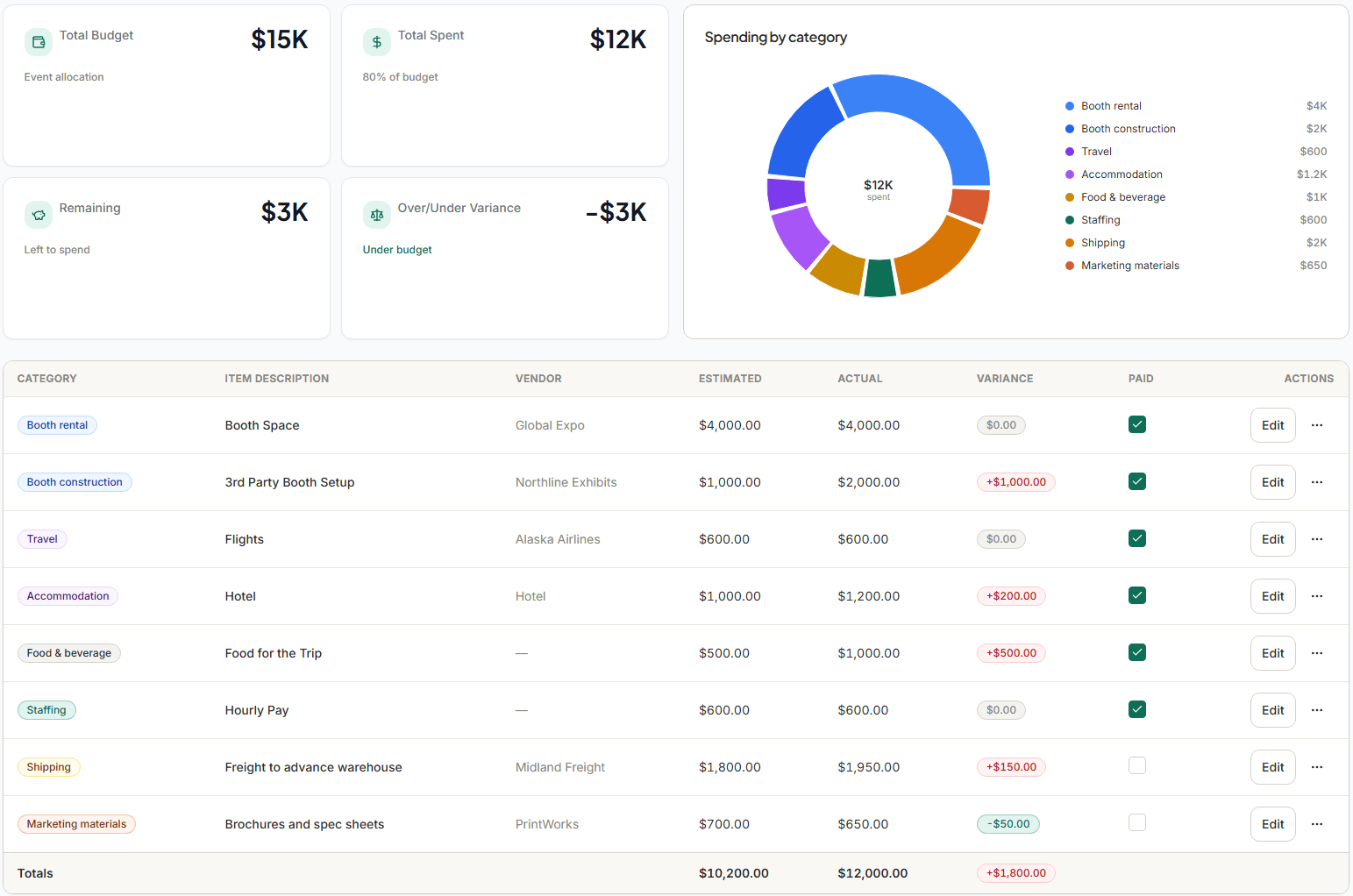
Use the column structure above to settle your categories and owners, then enter each line as quotes and invoices arrive. With actual costs and captured leads on the same event, Boothlyo calculates cost per lead for you — and ROI once you add the revenue attributed to the show — instead of leaving it to a post-show spreadsheet. It's one part of how Boothlyo supports the whole exhibiting program.
Start with the template, finish with discipline
- Copy the eight categories and spreadsheet columns before you sign the booth contract.
- Assign an owner per category with approval limits.
- Book travel and freight early — the cheapest line items to control.
- Close actuals within ten days and calculate CPL while memory is fresh.
- Present one-page ROI to leadership within two weeks.
Track your trade show budget in Boothlyo. Get started at boothlyo.com/signup and run your next show budget alongside checklists, staff, and lead capture in one place.