Trade Show Planning Timeline: Week-by-Week Checklist for Exhibitors
By Boothlyo TeamPublished 9 min read
A week-by-week trade show planning timeline for exhibitors
Exhibiting without a timeline means graphics ship late, warehouse deadlines slip, and staff book hotels at triple rate. A timeline matters because dates are fixed — the show will open whether you are ready or not.
This timeline runs three months before doors through post-show ROI — use it as your master schedule and assign owners per task.
Three months before the show
Register and contract. Reserve booth space, sign contract, pay deposit, complete exhibitor registration in portal.
Book hotel rooms. Convention city blocks sell out — finance may need early approval.
Book flights. Especially international or peak-season shows.
Reserve booth space details confirmed. Number, size, orientation, included services.
Start booth design process. Concept layout, budget envelope, vendor quotes.
Create the event in your planning hub — Boothlyo or equivalent — so every deadline below has an owner and date.
Eight weeks before
Confirm booth dimensions in writing. Width, depth, height limits, hanging sign rules.
Order booth graphics and displays. Production timelines often need 3–4 weeks.
Plan staffing. Names, roles, travel roster — see staff management guide.
Set budget. Eight categories, contingency, approval thresholds — budget template.
Six weeks before
Order printed materials. Brochures, cards, spec sheets — quantities tied to traffic plan.
Book show services. Electricity, internet, cleaning, rigging per exhibitor manual.
Plan shipping strategy. Advance warehouse vs direct; carrier quotes — shipping guide.
Set up lead capture form. Fields, scoring, CRM test.
Four weeks before
Ship to advance warehouse. Meet cutoff; confirm labels and manifest.
Confirm all bookings. Hotels, flights, services, freight.
Brief the team (first pass). Messaging, roles, capture mechanics.
Finalize giveaways. Qualification strategy — giveaway ideas.
Two weeks before
Confirm warehouse receipt. Tracking + confirmation email saved.
Pack carry-on essentials. Laptop, adapters, cards, meds, QR backups.
Final team briefing. Role-play, demo, escalation paths.
Print QR codes and backup paper forms.
Run 75-item booth checklist verification.
Show week
Setup day
- Check in with show management if required
- Meet decorator; verify power/internet orders
- Build booth; test tech and lead capture
- Photo document finished booth
- Team huddle before opening
Daily show days
- Morning power/WiFi/capture test
- Shift rotation per schedule
- Hourly traffic notes if tracking
- Score leads continuously
- End-of-day export and huddle
Teardown day
- Inventory vs manifest
- Return labels on outbound freight
- Save tracking numbers
- Secure assets traveling home
Detailed day-of tasks live in booth setup guide.
Post-show (first two weeks)
48-hour follow-up window. Hot and warm sequences — lead follow-up guide.
Learnings documentation. Booth, messaging, freight issues, staffing.
ROI calculation. Close actuals, CPL, pipeline — ROI calculation.
Debrief team. Roles, energy, qualification quality.
Planning next year. Update checklist, budget assumptions, show selection.
Why a living timeline beats a static PDF
PDF timelines go stale the moment a vendor misses a date. In a shared planning tool like Boothlyo, every task has an owner and a due date, and checklists, budget, shipments, and staff sit on one event record — so three months of work does not live in twelve tools.
One timeline, one team
Copy this schedule into your next event. Adjust for show-specific manual deadlines (some warehouses are four weeks, not two). The exhibitors who win are not luckier — they are earlier.
Adapting the timeline to your show calendar
Not every show offers three months lead time. For rush registrations, compress but never skip: dimensions confirmed before graphics, services ordered before warehouse cutoff, lead capture tested before travel. Cut swag before you cut freight confirmation.
International exhibits add customs documentation six to eight weeks out — add those rows to your timeline tab.
Multi-show seasons stack timelines — offset graphics production so two warehouses do not share the same ship week without ops bandwidth.
Shared tools vs shared spreadsheets
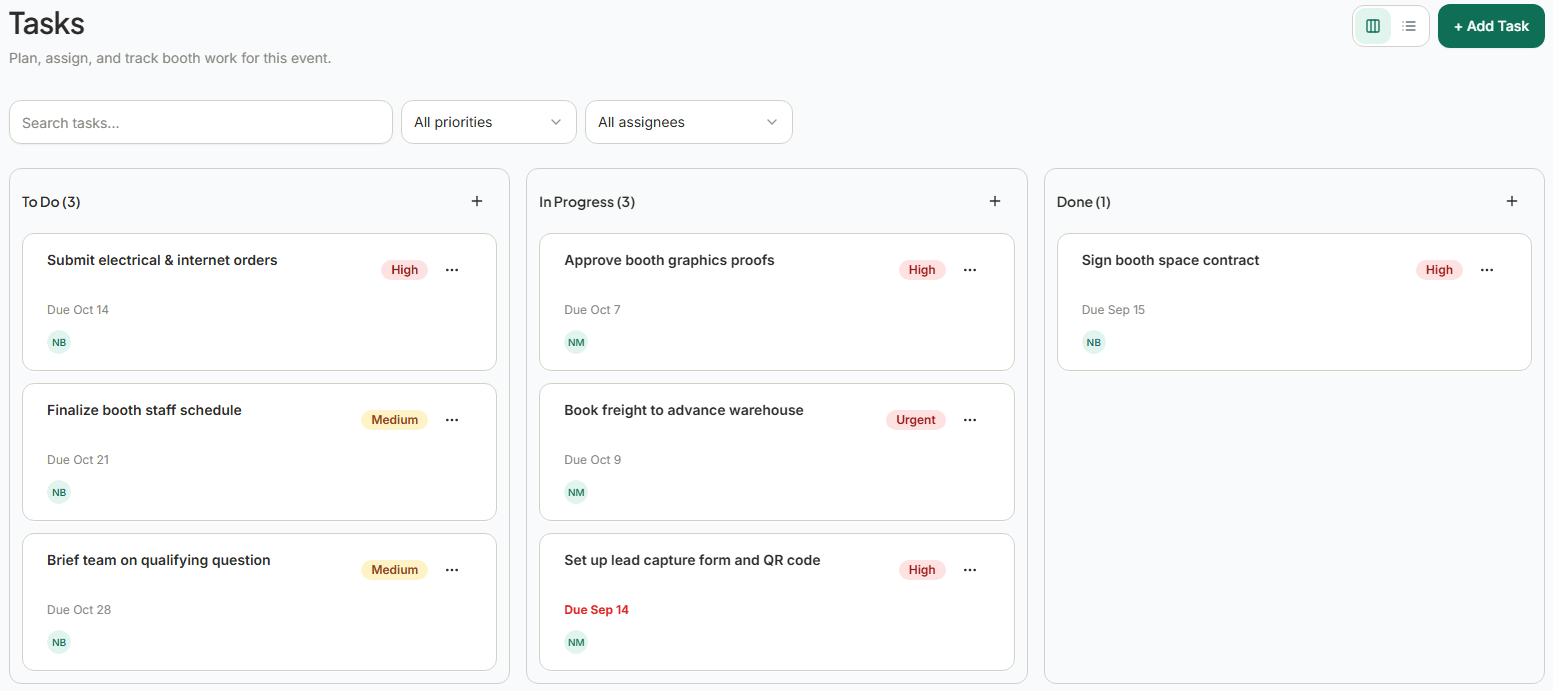
Spreadsheets lack clear ownership and links between budget lines and checklist rows. A planning tool should mirror how exhibitors think: one event, many workstreams, fixed opening day. In Boothlyo, overdue tasks are flagged on the shared task board, so when an owner misses a date the whole team can see it — not a surprise in a tab nobody opened.
Handoff between marketing and sales on the timeline
Marketing often owns weeks 12–4; sales owns show week and follow-up. Document the handoff date explicitly on the timeline: when lead definitions become sales SLAs, when meeting targets are agreed, when nightly hot-lead review happens. Ambiguity here destroys ROI more than a mediocre backdrop.
Sample owner assignments by workstream
| Workstream | Typical owner |
|---|---|
| Budget and finance | Marketing ops |
| Booth design and graphics | Marketing |
| Freight and services | Operations |
| Lead capture and CRM | Marketing + sales ops |
| Staffing and travel | Sales manager |
| Show week sales execution | Sales leadership |
| Post-show follow-up | Sales development |
Publish this RACI in week one so tasks on the timeline have names, not departments. If you exhibit several times a year, this is where managing your exhibiting program in one system pays off: the same workstreams and owners, with new dates for each show.
Milestone checkpoints leadership cares about
At 8 weeks, approve budget and booth design. At 4 weeks, confirm warehouse receipt and services orders. At 1 week, sign off on staffing and lead capture test. At +2 weeks post-show, receive ROI slide with recommendation. Mapping timeline milestones to executive checkpoints prevents last-minute surprises and keeps exhibit programs funded.
Duplicate this timeline for every show on your calendar — each event gets its own dates, but the workstreams stay the same. Mature exhibit teams reuse the template and only adjust weights (more freight focus for custom builds, more staff focus for high-traffic pavilions).
Manage your trade show plan in Boothlyo. Start free at boothlyo.com/signup and run three months of exhibit prep from one shared plan.